Home > Products > SenSpot™ > Wireless Water Velocity
The Wireless Water Velocity SenSpot™ is a high-performance, scalable solution for monitoring open channels. This wireless water flow sensor uses surface velocity radar technology, specifically the OTT SVR 100 for accurate and non-contact flow measurement in open channels and rivers.
Designed for ultra-energy efficient wireless communication, the SenSpot™ sensor operates maintenance-free for over a decade, requiring no calibration or battery replacement after installation. Its small size and lightweight design, combined with adhesive mount options, make it easy to install at multiple locations with minimal effort. Mounted above the water surface, the sensor is protected from floating debris and other disturbances, ensuring accurate and continuous measurements. Surface velocity readings are applicable for discharge computation based on the index – velocity – method.
The Surface velocity radar sensor has the capability of identifying data influenced by sensor movement (e.g., wind, traffic) using meta data from integrated vibration and tilt sensors. This device applies filters to automatically minimize noise effects of wind, precipitation, vibration, or waves to detect flow direction automatically.

without battery replacement

0.1°C (0.05°F) resolution

Self-adhesive(e.g. steel)/
flange-mount(e.g. concrete)

1 km fee space

easy to reuse in other places

-40 to +65°C (-40 °F to +150°F)
• Long Battery Life with Solar Power.• Easy Mounting: Flange mount or adhesive tape.• Maintenance-free: No post-installation maintenance required.• Self-sufficient energy: Solar panel ensures continuous operation without external power needs.• Durable solution: Provides reliable non-contact surface velocity measurements under various flow conditions.• Advanced filtering: Reduces the impact of wind, precipitation, vibration, or waves for accurate data.
• Water Resource Management: Monitor flow rates in rivers, streams, canals, and irrigation channels for efficient water management.• Flood Warning Systems: Provide early detection and real-time data for flood control.• Environmental Monitoring: Assess scour risks, and monitor hydro meteorological conditions.• Oceanographic Research: Study ocean currents and surface water movement.• Scientific Research: Gather valuable data on water dynamics for academic studies and research projects.

A wireless water velocity sensor is a monitoring device used to measure the speed of flowing water in rivers, canals, drainage systems, and other water bodies. The sensor collects flow data and transmits it wirelessly to a monitoring platform for real-time analysis and water management.
A wireless water velocity sensor measures the speed of moving water using a Doppler radar–based sensing concept. The instrument emits electromagnetic signals toward the water surface and analyzes the Doppler shift of the reflected signal to determine surface flow velocity. The measured data is then transmitted wirelessly to a gateway or monitoring system, enabling engineers to remotely monitor water flow conditions in real time.
Wireless water velocity sensors are widely used in rivers, stormwater systems, canals, drainage channels, dams, and flood monitoring stations. They help monitor water flow conditions and provide important data for environmental monitoring and infrastructure management.
Monitoring water velocity helps engineers understand flow patterns and detect changes that may increase the risk of flooding, erosion, or sediment movement. Continuous monitoring with a water velocity sensor provides valuable data for effective water resource management.
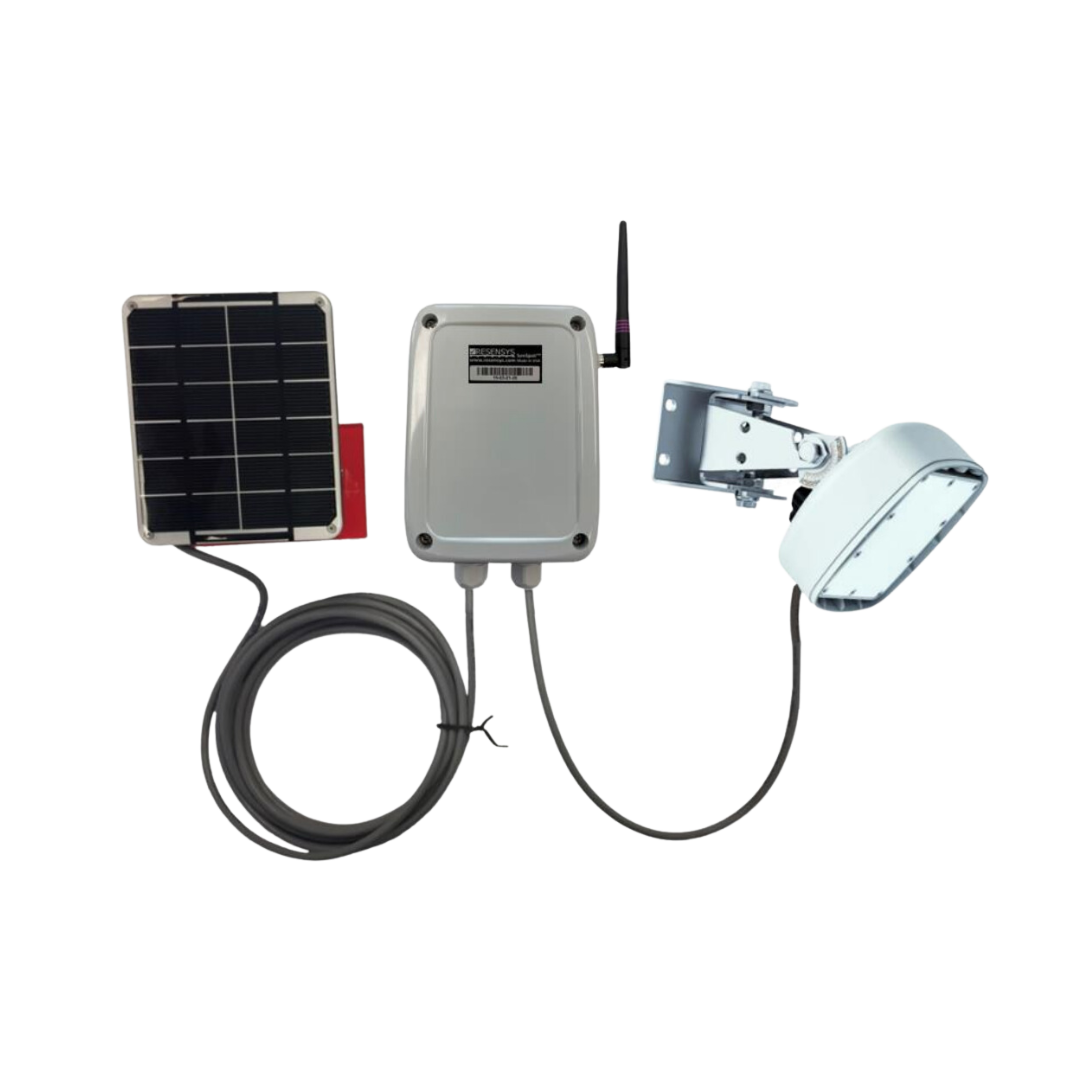
▪ Long lifetime: No battery replacement is needed after installation
▪ Wireless communication: IEEE 802.15.4
▪ Wireless communication range: 1.0km (0.62 mile) free space
▪ Ingress Protection: IP67, weatherproof, waterproof, protected against rain, snow, and UV exposure
▪ Working temperature: -40°C to +85°C (-40°F to +185°F)
▪ Accuracy:
✓ +/- 2% of measured value (0.08 m/s to 4 m/s) (0.26 to 13.12 ft/s)
✓ +/- 2.5% of measured value (4 m/s to 12 m/s) (13.12 to 39.37 ft/s)
▪ Resolution: 0.1 mm/s (0.0003 ft/s)
▪ Measurement range velocity: 0.08 to 15 m/s (0.26 to 49.12 ft/s), depending on flow conditions
▪ Direction distance: 1 to 50 m (3.3 to 164 ft.)
▪ Distance Water: 0.5 to 25 m (1.64 to 82 ft.)
▪ Rotation range of swivel mount:
✓ Lateral axis: ± 90°
✓ Longitudinal axis: ± 15°
▪ Dimensions:
✓ Wireless transceiver box: 140mm (5.50”) x 105mm (4.12”) x 62mm (2.44”)
✓ Velocity sensor: 134.5mm (5.3”) x 114.5mm (4.5”) x 80mm (3.2”)
✓ Solar panel: 140mm (5.5”) x 114 mm (4.5”) x 89 mm (3.5”)
▪ Weight:
✓ Wireless transceiver: 120 g (4.2 oz)
✓ Velocity sensor (without mounting bracket): 820 g (28.9 oz)
✓ Velocity sensor (with mounting bracket): 1530 g (54 oz)
✓ Solar panel: 100 g (3.5 oz)

Small wireless sensors that
make big differences
Address: 6517 Mid Cities Ave.
Beltsville MD 20705
USA
E-Mail: info@resensys.com
Phone: (301) 477 3075