Home > Products > SenSpot™ > Wireless Geophone
SeniMax™ Wireless 3D Geophone provides a robust solution for collecting seismic data and monitoring structural vibration analysis. This wireless geophone offers efficient and maintenance-free operation, with a high-capacity lithium-ion battery charged by a solar panel. The transceiver and solar panel can be mounted using a flange or adhesive, making installation simple. The wireless seismic geophone meets IP66 standards, ensuring it is weatherproof and suitable for outdoor seismic monitoring applications in hard-to-reach places. Equipped with HS-1 or GS-One Geophones from Geospace Technologies, this rugged sensor converts mechanical motion into electrical signals proportional to relative velocity, essential for monitoring machinery vibration.
The Wireless Geophone SeniMax™ uses Resensys proprietary technology, which enables large-scale sensing, wireless synchronization, and ultra-energy-efficient wireless communication. It can also serve as a gateway to collect data from other SenSpot™ sensors. The geophone's flanged sensing element facilitates easy installation for earth seismic movement monitoring, with adjustable detection thresholds and sampling intervals to meet specific application needs.

without battery replacement

0.1mm/s (0.004 in/sec) resolution

self-adhesive(e.g. steel)/
flange-mount(e.g. concrete)

1 km fee space

easy to reuse in other places

-40 to +65°C (-40 °F to +150°F)
• Long lifetime• Stand-alone IoT device• Ingress Protection (IP66)• Maintenance-free• Adjustable threshold and sample interval
• Seismic Monitoring: Detect earthquakes, tremors, and other seismic events.• Structural Integrity Monitoring: Assess the vibration response of buildings, bridges, tunnels, wind turbines and other critical infrastructure.• Machinery Monitoring: Monitor vibration levels in industrial equipment to optimize performance and prevent failures.• Construction Site Monitoring: Monitor vibrations in structures adjacent to heavy construction activities to ensure structural integrity and safety.

A wireless geophone sensor is a device used to detect and measure ground vibrations and seismic activity. It converts ground motion into electrical signals and transmits the data wirelessly to a monitoring system for analysis in structural health monitoring and vibration studies.
A wireless geophone uses a sensitive internal mechanism that moves when ground vibrations occur. The movement generates an electrical signal proportional to the vibration. The sensor then sends this vibration data wirelessly to a central monitoring platform for real-time analysis.
Wireless geophones are commonly used for vibration monitoring, seismic monitoring, structural health monitoring, construction site monitoring, and infrastructure protection. They help engineers detect vibrations caused by traffic, construction activities, earthquakes, or nearby blasting operations.
Vibration monitoring helps engineers detect excessive ground movement that may affect structural stability. Using a wireless geophone sensor, engineers can track vibration levels near bridges, tunnels, railways, and buildings to prevent structural damage and ensure safety.
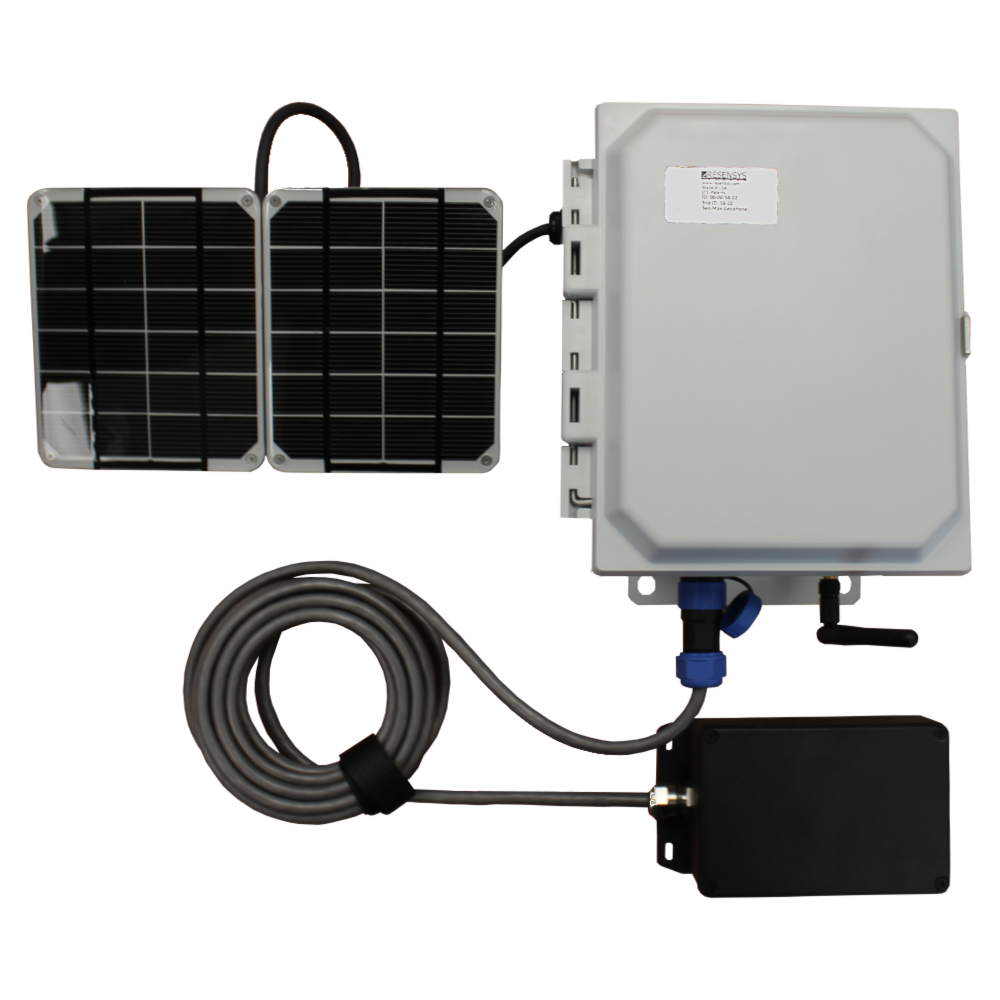
• Long lifetime: No battery replacement is needed after installation
• Lightweight:
○ Wireless transceiver: 1.5kg (3.3 lb)
○ Sensing element: 0.9kg (2lbs)
○ Solar panel: 100 g (3.5 oz)
• Easy mounting:
○ Self-adhesive, no drilling is required (e.g. steel)
○ Flange-mount, drilling is required (e.g. concrete)
○ Quick installation, 1-2 minutes
• High accuracy:
○ full range: -0.21 m/s to +0.21m/s (-14.35 in/s to +14.35 in/s)
○ Resolution: 0.1 mm/s (0.004 in/s)
• Wide working temperature: -40 to +65°C (-40 °F to +150°F)
• Long communication range: 1.0km free space
(0.6 mile) • Complementary data collected: temperature, battery voltage, etc.

Small wireless sensors that
make big differences
Address: 6517 Mid Cities Ave.
Beltsville MD 20705
USA
E-Mail: info@resensys.com
Phone: (301) 477 3075