Home > Products > SenSpot™ > Wireless Tilt/Inclination SenSpot™
The Wireless Tilt/InclinationSenSpot™ sensors offer advanced technology for precise monitoring of tilt and inclination. Utilizing Resensys proprietary sensing, scheduling, and ultra-low power synchronization technology, these wireless tilt sensors provide real-time data on movement, settling, deformation, and abnormal tilting of structural components. Designed to be maintenance-free for a decade, these sensors do not require calibration or battery replacement after installation. The high precision data from these wireless tilt sensors helps in calculating vertical and horizontal displacement of piers, pylons, and spans, ensuring early detection of potential issues.
As part of the Resensys integrity monitoring system, the Wireless Tilt/Inclination SenSpot™ can monitor the smallest movements of structural components such as piers, decks, and bearings on a highway bridge. Additionally, these wireless inclinometer sensors track changes due to temperature variations in bridges, buildings, dams, and other structures. They are ideal for monitoring the deflection, bending, and settling of piers and abutments with high precision, as well as changes in tilt caused by settling, deformation, or loading.

without battery replacement

Narrow Range HRT: ≤0.0003⁰ (5.2 µrad)
Mid-Range HRT: ≤ 0.003⁰ (52 µrad)
MRT: 0.01⁰ (0.2 mrad)

self-adhesive(e.g. steel)/
flange-mount(e.g. concrete)

1 km free space

easy to reuse in other places

-40 to +65°C (-40 °F to +150°F)
• Long lifetime (battery life of up to 10 years)• Adjustable sampling interval (12 seconds to 6 minutes)• Easy mounting (flange-mount or adhesive tape)• Communication range (300m/980 ft)• 2D-Measurement (monitoring the tilt of the whole surface)
• Monitors deflection, bending, settling, and displacement of piers, abutments, bearings, and expansion joints with high precision (resolution 0.00016 degrees or 0.5 arc seconds).• Detect changes in tilt due to settling, deformation, permanent loading changes, or unhealthy over-tilting that may compromise structural safety.• Tracks health & stability of structures like bridge, building, dam and tunnel.• Monitors retaining wall movements and scour-critical bridge.• Monitors infrastructure like railways, roads and wind turbine tower foundation integrity.• Automation technology and aerospace engineering applications.• Other applications include monitoring Construction Sites, Landslide and Nuclear Power Plant.

A wireless tilt sensor measures the angle or inclination of a structure relative to gravity. It is commonly used to monitor structural movement, deformation, and potential instability in bridges, buildings, towers, retaining walls, and other infrastructure.
A wireless tilt sensor uses an internal accelerometer or MEMS technology to detect changes in angle. When a structure tilts or shifts, the sensor measures the change in inclination and wirelessly transmits the data to a monitoring system for analysis.
A wireless inclinometer sensor is a device used to measure the tilt or angular movement of a structure. It monitors changes in inclination and transmits the data wirelessly to a monitoring system, helping engineers track structural movement and detect potential deformation or instability.
The wireless inclinometer SenSpot can be used to monitor foundation stability, settlement, and angular movement caused by scour, thermal, and geotechnical effects. The sensors can also be used to quickly assess structural integrity after major distress events such as earthquakes or floods.
In addition, wireless inclinometers can be used to monitor angular movement in structural elements such as rocker bearings and bridge hangers. Moreover, arrays of high-precision inclinometers can be used to monitor deflections and vertical displacement of bridge girders under thermal loads, as well as track changes in stiffness over the long term.
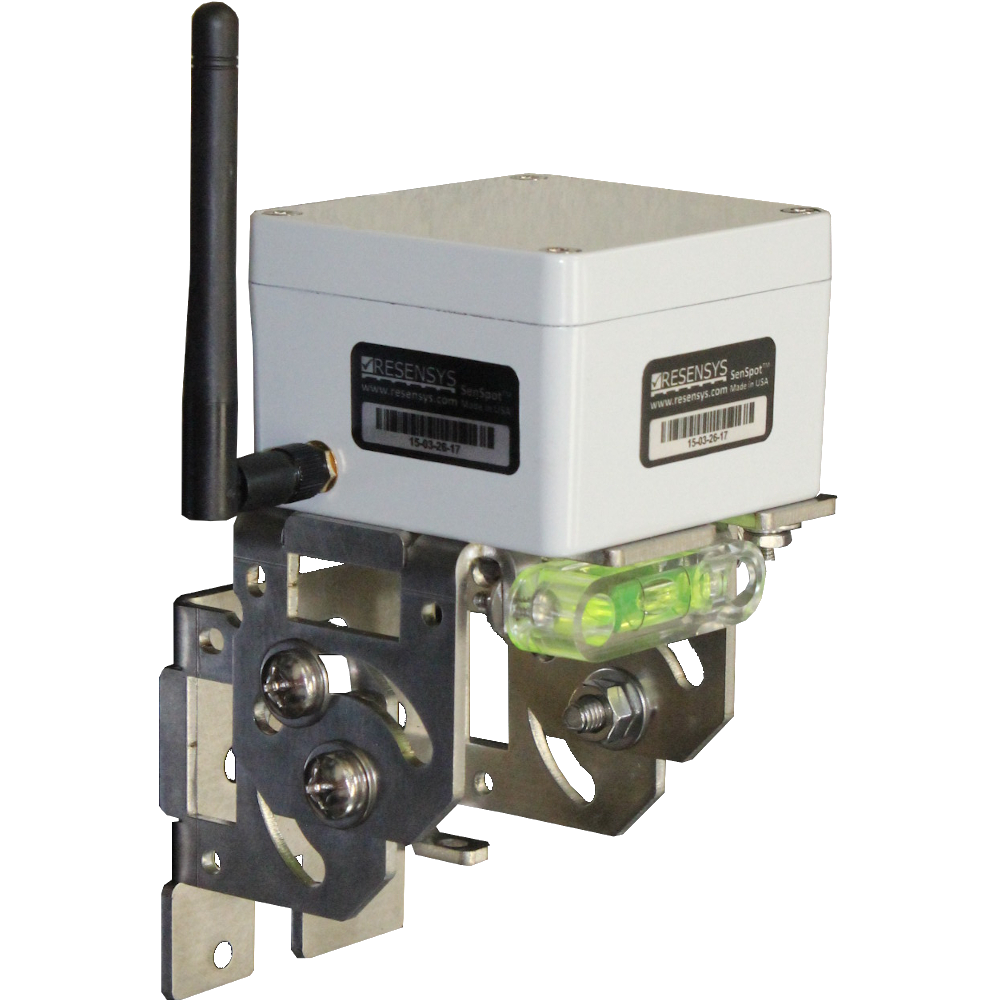
• Lightweight: about 400 g (14 oz.)
• Long lifetime: minimum expected life without battery replacement 10 years
• Easy mounting:
○ Self-adhesive, no drilling is required (e.g. steel)
○ Flange-mount, drilling is required (e.g. concrete)
○ Quick installation, 1-2 minutes
• High accuracy:
○ Narrow Range HRT: ≤0.0003°
○ Mid-Range HRT: ≤0.003°
• Wide working temperature: -40 to +65°C (-40 °F to +150°F)
• Long communication range: 1.0km free space
• Size:
○ Wireless transmitter: 79.6mm (3.13”) x 74.6mm(2.94") x 52mm x (2.05”)
○ Assembly Dimension: 120.8mm (4.76”) x 96.6mm (3.8”) x 149.9mm (5.9”)
• Complementary data collected: temperature, battery voltage, etc.
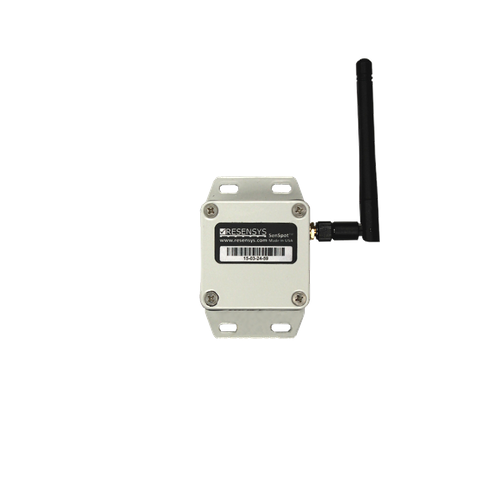
• Lightweight: about 180 g (6.3 oz.)
• Long lifetime: minimum expected life without battery replacement 10 years
• Easy mounting:
○ Self-adhesive, no drilling is required (e.g. steel)
○ Flange-mount, drilling is required (e.g. concrete)
○ Quick installation, 1-2 minutes
• High accuracy:
○ Mid-Resolution MRT: 0.01°
• Wide working temperature: -40 to +65°C (-40 °F to +150°F)
• Long communication range: 1.0km free space
• Size:
○ Wireless transmitter: 140mm (5.5”) x 60mm(2.38″) x 32.5mm x (1.28”)
• Complementary data collected: temperature, battery voltage, etc.

Small wireless sensors that
make big differences
Address: 6517 Mid Cities Ave.
Beltsville MD 20705
USA
E-Mail: info@resensys.com
Phone: (301) 477 3075