Home > Products > SenSpot™ > Wireless Vibration/Acceleration SenSpot™
Resensys Wireless vibration accelerometer SenSpot™ sensor offers a reliable and efficient solution for monitoring structural vibrations. This wireless accelerometer sensor provides accurate and real-time data on vibrations, enabling early detection of potential issues. Equipped with a long-lasting battery and a compact design, the SenSpot™ sensor requires minimal maintenance and can be easily deployed in various environments.
The wireless accelerometer and vibration sensor uses Resensys proprietary technology to deliver high-performance wireless communication and data collection. With its compact and durable design, the SenSpot™ vibration sensor can be easily installed in diverse environments. SenSpot™ accelerometer sensors detect changes in acceleration and start sampling and transmitting acceleration values when a vibration event is detected. This feature allows for real-time monitoring of vibration and acceleration in all directions.

without battery replacement

4µg resolution

self-adhesive(e.g. steel)/
flange-mount(e.g. concrete)

1 km free space

easy to reuse in other places

-40 to +65°C (-40 °F to +150°F)
• Long lifetime (battery life of 10 years)• Adjustable sampling interval (50 to 500 samples per second)• Adjustable sensitivity threshold (8mg to 512mg)• Small size (59mm)• Ingress Protection: IP67, waterproof
• Monitors single-axis or tri-axial acceleration.• Calculates natural frequencies/modal analysis and detects shifts in natural frequencies.•
Structural Health Monitoring: Assess the vibration response of buildings, bridges, and other structures.•
Machinery Monitoring: Monitor equipment vibration to optimize performance and prevent failures.•
Construction Site Monitoring: Monitor vibration levels during construction activities.• Industrial Process Monitoring: Monitor vibration in industrial machinery and equipment.

A wireless vibration sensor, also known as an accelerometer, measures vibration, acceleration, and movement in structures or machinery. It wirelessly transmits vibration data to a monitoring system, allowing engineers to analyze structural behavior and detect unusual vibration patterns that may indicate damage or mechanical issues.
A wireless vibration accelerometer uses internal sensing elements to measure acceleration caused by vibrations. The sensor converts this motion into digital data and transmits it wirelessly to a monitoring gateway or software platform for real-time analysis and long-term structural monitoring.
Wireless vibration sensors are widely used in bridges, buildings, industrial equipment, wind turbines, railways, and infrastructure projects. They help engineers monitor structural vibration, detect abnormal movement, and analyze structural performance under different load conditions.
Vibration monitoring helps engineers understand how a structure responds to loads such as traffic, wind, earthquakes, or machinery operation. Changes in vibration patterns may indicate structural damage, loosened components, or fatigue, making vibration monitoring essential for early problem detection.
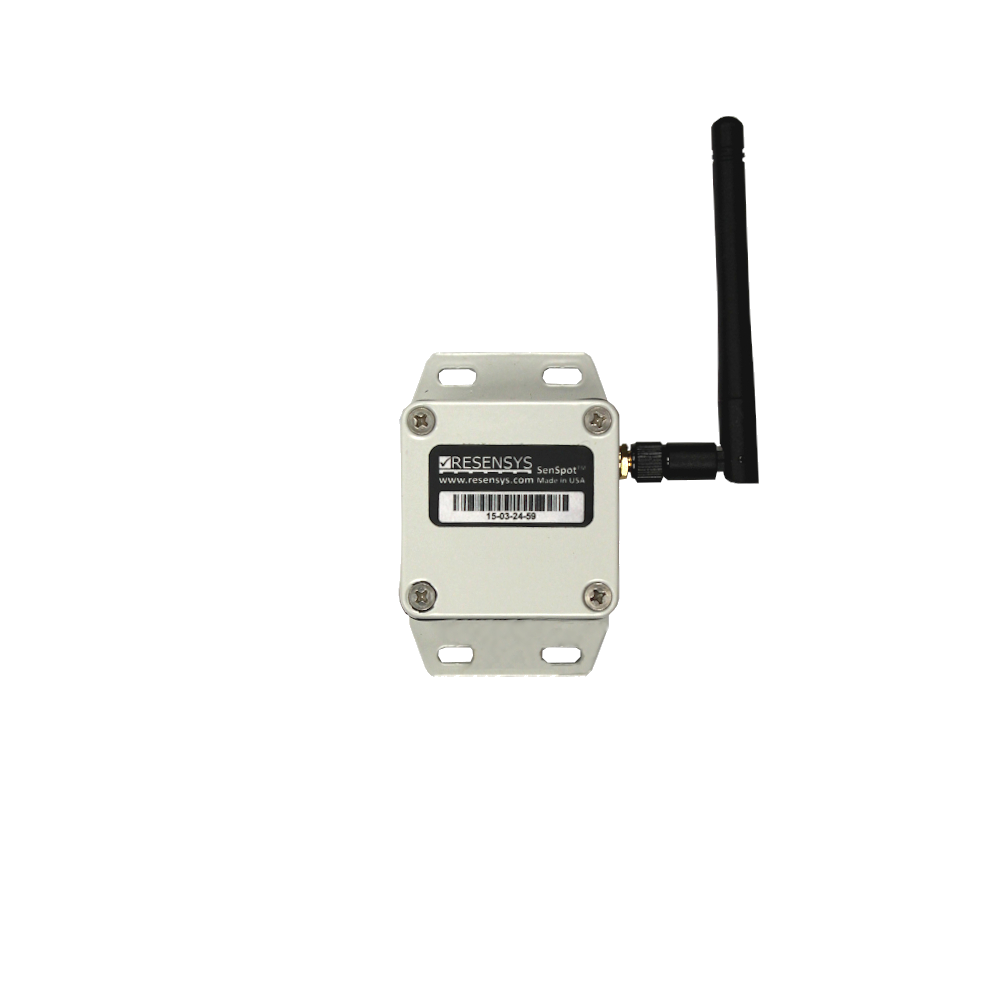
• Long lifetime: minimum expected life without battery replacement 10 years
• Lightweight: about 120 g (5.19 oz.)
• Easy mounting:
○ Self-adhesive, no drilling is required (e.g. steel)
○ Flange-mount, drilling is required (e.g. concrete)
○ Quick installation, 1-2 minutes
• High accuracy: 4µg resolution
• Wide working temperature: -40 to +65°C (-40 °F to +150°F)
• Long communication range: 1.0km free space
• Small size:
○ Wireless transmitter: 50mm (1.96”) x 50mm (1.96”) x 34mm (1.34”)
• Complementary data collected: temperature, battery voltage, etc.

Small wireless sensors that
make big differences
Address: 6517 Mid Cities Ave.
Beltsville MD 20705
USA
E-Mail: info@resensys.com
Phone: (301) 477 3075